
TL;DR
Prime for Young Adults — start your free trial
Fast free delivery, streaming and member deals for eligible 18–24 year olds.
Try it freeAs an affiliate, we earn on qualifying purchases.
Building your own AI workstation used to be cheaper, but today prebuilt systems often match or beat DIY prices due to component shortages and bulk buying. The choice depends on your budget, expertise, and whether you value convenience or customization.
Imagine this: you’re ready to jump into AI development, but the hardware scene has changed. The once clear-cut choice between building your own machine or buying prebuilt is now blurred, especially with the rise of prebuilt AI workstations. With skyrocketing component prices and supply chain hiccups, the usual DIY bargain isn’t as straightforward as it used to be.
This guide breaks down what really matters—cost, performance, ease, and future-proofing—so you can pick the right path for your AI projects today. Whether you’re a hobbyist, a researcher, or a startup, understanding these shifts will save you time and money.
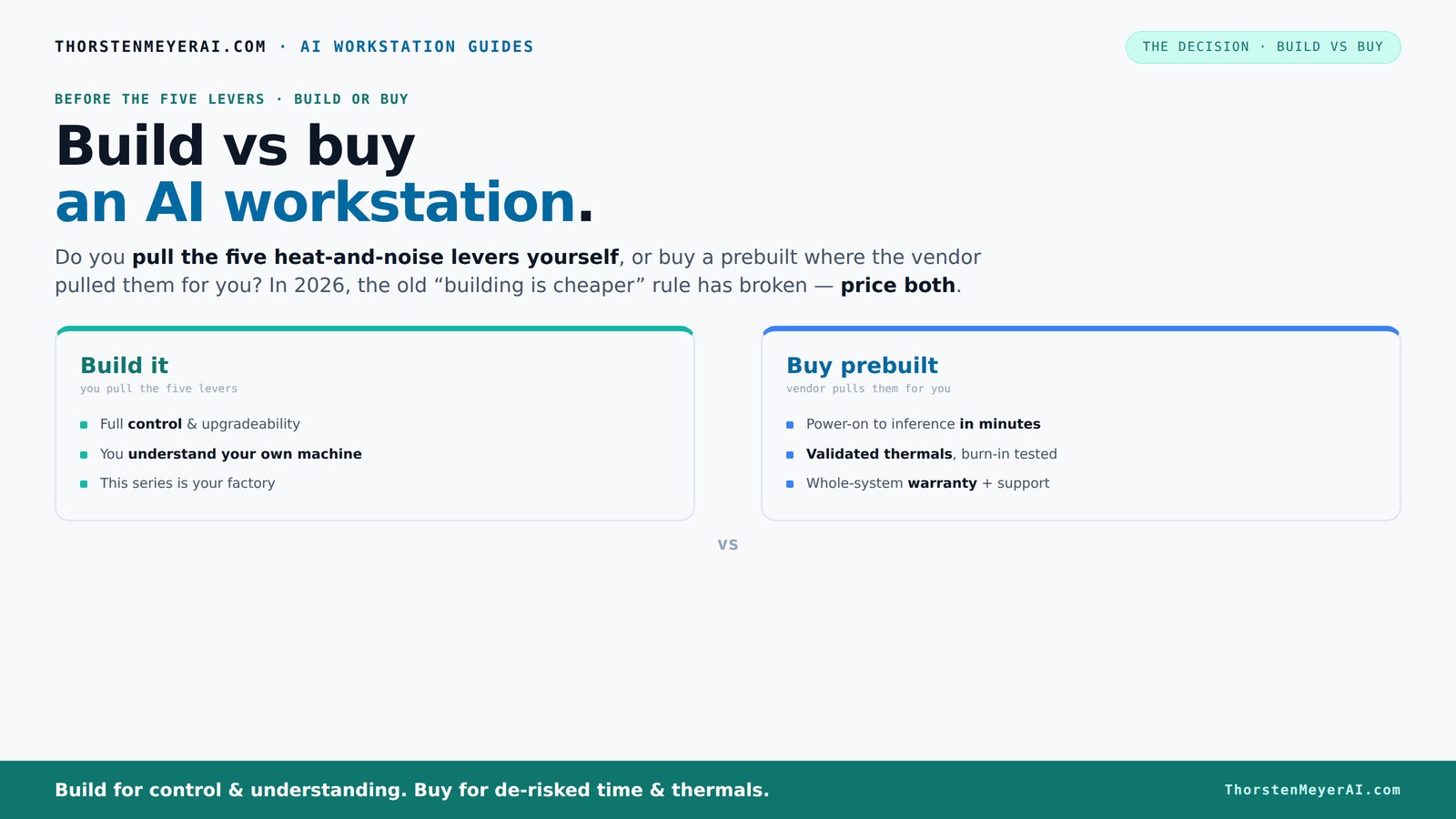
Build vs buy
an AI workstation.
The real question behind this whole series: do you pull the five heat-and-noise levers yourself, or buy a prebuilt where the vendor pulled them for you? And in 2026, the old “building is cheaper” rule has broken. Match your situation in Part 3.
Key Takeaways
- Component shortages in 2026 mean prebuilt AI workstations often match or beat DIY prices, reversing the traditional build-cheaper rule.
- Prebuilt vendors validate thermals and performance, reducing risk of throttling during long AI training runs.
- DIY offers maximum customization and upgradeability, but requires time, technical skill, and thermal management knowledge.
- Buying prebuilt saves setup time, minimizes troubleshooting, and includes warranty support—ideal for professionals needing quick deployment.
- Your decision depends on whether you prioritize control and cost savings or convenience and reliability.
As an affiliate, we earn on qualifying purchases.
Why the old rule 'Build is Cheaper' No Longer Holds Water
Historically, building your own AI workstation saved money because you could cherry-pick components and avoid markup. But in 2026, that story has flipped. Major shortages have pushed prices of GPUs, RAM, and SSDs sky-high—sometimes 30-50% above pre-pandemic levels.
For example, a top-tier NVIDIA RTX 4090 GPU that once cost around $1,500 now often sells for over $2,000 due to supply constraints. Meanwhile, prebuilt vendors like Lambda pre-purchase in bulk, securing better prices that they pass on to you. So, a high-end system that used to cost $1,500 in parts might now be available preassembled for less than building it yourself.
Understanding this shift is crucial because it changes the fundamental economic equation. For more insights, see our article on build vs buy AI workstations. The tradeoff between customization and cost has tilted toward prebuilt options, especially when considering the time saved and the risk of inflated component prices. It also means that the perceived savings of DIY are less reliable now, pushing many toward prebuilt solutions for value and convenience.
The Five Levers of Thermal and Noise Control—And Who Pulls Them
High-performance AI systems generate heat and noise. Managing these factors involves five levers: undervolting the GPU, matching the right cooling solution, optimizing case airflow, tuning fan curves, and positioning the system for optimal airflow.
If you build, you pull these levers yourself—choosing quiet GPUs, installing specialized coolers, and fine-tuning fans. This process requires a good understanding of thermal dynamics, as improper tuning can lead to overheating, reduced performance, or even hardware failure. The DIY route offers maximum control but demands time, technical skill, and ongoing maintenance.
If you buy a prebuilt, the vendor has already optimized these settings, validated thermals, and often includes water-cooling or advanced airflow solutions. Companies like BIZON even claim their systems run up to 30% cooler and quieter right out of the box. This factory validation can be a game-changer, especially in high-load AI tasks where thermal stability directly impacts performance and longevity. Learn more about thermal management for AI systems. The key implication is that prebuilt systems reduce the trial-and-error phase, lowering the risk of thermal issues that can degrade performance or shorten hardware lifespan.
The Cost of Convenience: When a Prebuilt Saves You Time and Frustration
Prebuilt AI workstations come with everything ready to run. No hunting for parts, no BIOS updates, no driver conflicts. Just power on and start training or inference. This seamless experience minimizes setup time and technical troubleshooting, which can be substantial for complex AI systems. For professionals whose time is valuable, that convenience often outweighs the higher sticker price.
Imagine a researcher needing to spin up a large model in days—buying a prebuilt with CUDA, PyTorch, and TensorFlow pre-installed cuts setup time from hours to minutes. Additionally, technical support from the vendor can quickly resolve hardware or software issues, reducing downtime and preventing costly delays. This support infrastructure is especially vital for teams without in-house hardware expertise, as it ensures the system can be operational with minimal fuss, ultimately enabling faster project timelines and more reliable performance. Consider reading about eldercare and assistive solutions for additional support options.
Upgradeability and Longevity: DIY or Prebuilt?
Building your own system usually means easier upgrades down the road. You can swap out GPUs, add RAM, or change cooling setups as needed—giving you flexibility to adapt to evolving AI workloads or hardware advancements. However, some prebuilt systems, especially those with proprietary parts or custom cases, limit future upgrade options. This can lead to higher long-term costs if you need to replace entire systems sooner than expected.
For example, a DIY build with standard ATX motherboards and open PCIe slots allows straightforward upgrades, supporting new GPUs or additional memory without much hassle. Conversely, some prebuilt configurations use proprietary cases or non-standard power supplies, which may require replacing the entire system for future upgrades. The tradeoff is between initial convenience and long-term flexibility. If you anticipate frequent hardware upgrades, building offers a more adaptable solution. But if you prefer a system that remains reliable and supported for several years, a high-quality prebuilt with upgrade paths can be a more practical choice, especially if vendor support simplifies future maintenance.
Performance and Validation: Do Prebuilts Really Beat DIY?
Prebuilt AI systems aren’t just assembled—they’re tested for sustained performance. Companies like Puget Systems run each system for 24–48 hours under load, ensuring thermal stability, stable power delivery, and no throttling. This rigorous validation process helps prevent performance drops during critical AI training or inference tasks, reducing risks associated with thermal or power issues that could cause crashes or hardware damage.
In contrast, a DIY build relies heavily on the user’s expertise to perform thorough testing. Without proper thermal tuning, overclocking, or power management, the system might overheat or underperform, risking throttling or failure. The implication is that prebuilt systems often deliver more consistent, reliable performance under demanding workloads, which is crucial for professional AI development where stability can directly impact results and project timelines.
The Final Decision: When to Build, When to Buy
If you enjoy hardware tinkering, have time, and want maximum control, building your own AI workstation might be the right choice. AI workstation makes sense. You can tailor every detail—cooling, noise, upgrade path—and potentially save money if you’re experienced. However, the tradeoff is the time investment and the risk of misconfigurations or thermal issues that can undermine performance.
But if you prioritize reliability, minimal setup, and the assurance of factory validation, a prebuilt system is your best bet. Especially when dealing with multi-GPU configurations or when you need a system ready to deploy immediately, vendor-prepared systems reduce headaches and mitigate risks associated with compatibility and thermal management. This choice is particularly compelling for professionals with tight deadlines or limited technical support at hand.
In today’s market, the decision is less clear-cut. Price, performance, and support all factor into the equation. Your personal priorities—whether you value maximum customization and cost savings or prefer convenience and peace of mind—will determine the best approach for your AI ambitions.
Frequently Asked Questions
Is it really cheaper to build my own AI workstation today?
Not always. Due to component shortages and bulk buying, prebuilt systems often match or beat DIY prices now. Always compare prices for your specific configuration before deciding.What hardware specs should I look for in an AI workstation?
Prioritize high-end GPUs like the NVIDIA RTX 4090 or A100, at least 64GB of RAM, fast NVMe SSDs, and a robust CPU such as AMD Ryzen Threadripper or Intel Xeon for best AI performance.How difficult is it to build an AI workstation myself?
It requires some technical know-how—understanding compatibility, assembly, and thermal tuning. However, many tutorials and guides can help you through the process step-by-step.Can I upgrade a prebuilt later?
Many prebuilt systems allow upgrades, but some use proprietary parts or limited space, making future upgrades more challenging. Check with the vendor about upgrade options before buying.Which brands are best for prebuilt AI workstations?
Lambda, Puget Systems, BOXX, and Dell’s Precision series are known for high-performance, AI-optimized systems with solid support and validation.Conclusion
In a market where supply chains shake up the old rules, your best choice hinges on what you value most. If you love tinkering and want every dollar saved, building keeps you in the driver’s seat. But if you need a system that just works—fast, reliable, and backed by support—buying prebuilt makes more sense.
Picture your ideal workspace: a quiet, cool powerhouse humming along, ready when you are. In 2026, that can be your choice—built or bought. The key is knowing which path aligns with your goals.
Flea & tick season Picks
flea and tick prevention
As an affiliate, we earn on qualifying purchases.