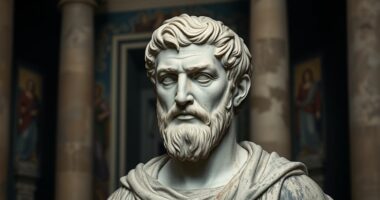

The Hellenistic era, sparked by Alexander the Great’s conquests, creates a turbulent backdrop that fosters the emergence of Stoicism, a philosophy focused on resilience and virtue. During this time, political upheaval and cultural exchanges challenge traditional values, inspiring thinkers to seek inner stability amid chaos. Stoicism’s emphasis on controlling emotions and living in harmony with nature was shaped by these turbulent events. If you want to understand how this philosophy responded to its era, keep exploring its fascinating origins and influence.
Key Takeaways
- The Hellenistic Era arose after Alexander the Great’s conquests, blending Greek culture with Eastern influences.
- Stoicism was founded in Athens during this period, emphasizing resilience, virtue, and rational control amid political upheaval.
- The era’s fragmented political landscape prompted philosophies like Stoicism to promote inner peace and ethical living.
- Stoicism was influenced by earlier Greek ideas, adapting to the chaos and uncertainty of the post-conquest world.
- The spread of Greek culture and texts during the Hellenistic period helped establish Stoicism as a major philosophical school.

Have you ever wondered how the cultural and political landscape of the ancient world transformed after Alexander the Great’s conquests? When Alexander’s armies swept through Persia, Egypt, and parts of India, they didn’t just conquer territories—they sparked a profound cultural exchange. The vast spread of Greek influence led to a new era known as the Hellenistic period, where ideas, art, and philosophies blended into a vibrant mosaic. One fascinating aspect of this era is how different schools of thought emerged, shaping people’s understanding of happiness, virtue, and the nature of the universe. Among these, epicurean philosophy gained prominence, emphasizing pleasure and the pursuit of tranquility, contrasting with other philosophical schools. These ideas didn’t develop in isolation but were a direct response to the changing political climate brought about by Alexander’s conquests. As Greek culture mingled with local traditions, communities sought new ways to navigate uncertainty and find personal fulfillment amidst political upheaval.
The conquests created a melting pot of ideas, and the Hellenistic philosophers took advantage of this environment to explore new ways of thinking. Epicurean philosophy, for example, was founded on the idea that pleasure is the highest good, but it’s a refined pleasure—focused on mental serenity rather than indulgence. You might find it intriguing that this school promotes simple living and friendship as keys to happiness, especially in a world shaking with chaos. Meanwhile, other schools like Stoicism emerged, emphasizing resilience and virtue, but all were shaped by the political chaos that followed Alexander’s conquests. The fragmentation of empire challenged traditional values, prompting thinkers to develop philosophies that provided stability and inner peace. These philosophies appealed to individuals seeking control over their emotions and fears amid the uncertainty of new rulers and shifting borders. Interestingly, the spread of Greek culture also facilitated the dissemination of ideas through various means, including texts and teachings carried across the empire.
As you explore this era, you’ll see how the conquests catalyzed intellectual diversity. Philosophers engaged with questions about nature, ethics, and the cosmos, creating a rich philosophical landscape. The spread of Greek ideas through the empire allowed these schools to flourish and influence later civilizations. The Hellenistic period’s complexity reflects a society adjusting to rapid change, where ideas like epicurean philosophy offered solace through understanding and moderation. It’s clear that Alexander’s conquests didn’t just reshape borders—they transformed how people thought about life, happiness, and their place in the universe. This period laid the groundwork for many philosophical traditions that continue to influence us today, reminding you that even in chaos, the pursuit of wisdom endures.

The Daily Stoic: 366 Meditations on Wisdom, Perseverance, and the Art of Living
As an affiliate, we earn on qualifying purchases.
As an affiliate, we earn on qualifying purchases.
Frequently Asked Questions
How Did Stoicism Influence Later Philosophical Movements?
You see, Stoicism greatly influenced later philosophical movements by inspiring Neo-Stoic adaptations that emphasized reason, virtue, and self-control. Its ideas also carried an Epicurean influence, blending resilience with a focus on personal well-being. These philosophies shaped modern ideas about ethics, self-mastery, and rational living, enabling thinkers to develop new approaches to life’s challenges. Your understanding of Stoicism reveals its lasting impact on philosophy and personal development.
What Role Did Alexander the Great Play in Hellenistic Culture?
Did you know that Alexander the Great’s military conquests spread Greek culture across three continents? His campaigns fostered Hellenistic cultural fusion, blending Greek ideas with Persian, Egyptian, and Indian traditions. By doing so, Alexander played a pivotal role in shaping the cultural landscape of the Hellenistic era, making it a vibrant, diverse period that influenced art, philosophy, and science for centuries. His legacy truly transformed the ancient world.
Were There Significant Differences Between Early and Later Stoic Teachings?
You’ll notice significant differences between early and later Stoic teachings due to ethical evolution and doctrinal shifts. Early Stoics focus on virtue as living in accordance with nature, emphasizing personal discipline. In later stages, teachings expand to include cosmopolitanism and practical ethics, making Stoicism more accessible. These shifts reflect an adaptation to changing societal values, broadening its appeal and deepening its philosophical scope over time.
How Did Hellenistic Art Reflect Philosophical Ideas of the Time?
Did you know over 80% of Hellenistic art features symbolic sculptures and mythological motifs? These artworks vividly reflect the philosophical ideas of the time by emphasizing themes like virtue, heroism, and the divine. You’ll notice how sculptures embody Stoic ideals of inner strength and harmony, using mythological figures to symbolize moral virtues. This artistic expression helps you understand how philosophy and art intertwined during the Hellenistic era.
What Was the Daily Life of a Hellenistic Philosopher Like?
You spend your days immersed in study and reflection, often living in modest quarters that foster focus. Your daily routines include reading, debating, and practicing self-discipline, aligning with your philosophical beliefs. You seek tranquility and virtue, dedicating time to meditation and ethical discussions. Social interactions are essential, and you often gather with fellow philosophers to exchange ideas, all while maintaining a simple, disciplined lifestyle rooted in your pursuit of wisdom.

Hellenistic Philosophy (Hackett Classics)
Used Book in Good Condition
As an affiliate, we earn on qualifying purchases.
As an affiliate, we earn on qualifying purchases.
Conclusion
As you’ve seen, the Hellenistic era is a treasure trove of wisdom, shaping philosophies like Stoicism that still echo through time. By understanding this vibrant period, you access the secrets to resilience and inner peace that can transform your life. Think of it as discovering the guiding star that lights your path through chaos—so powerful, it’s almost like holding the universe’s own blueprint for calm amidst the storm.

The Enchiridion: Timeless wisdom of ancient philosophy for mental clarity, inner discipline, emotional resilience, and a life guided by calm, reason, and virtue
As an affiliate, we earn on qualifying purchases.
As an affiliate, we earn on qualifying purchases.

Ancient Greek Philosophers (Leather-bound Classics)
As an affiliate, we earn on qualifying purchases.
As an affiliate, we earn on qualifying purchases.