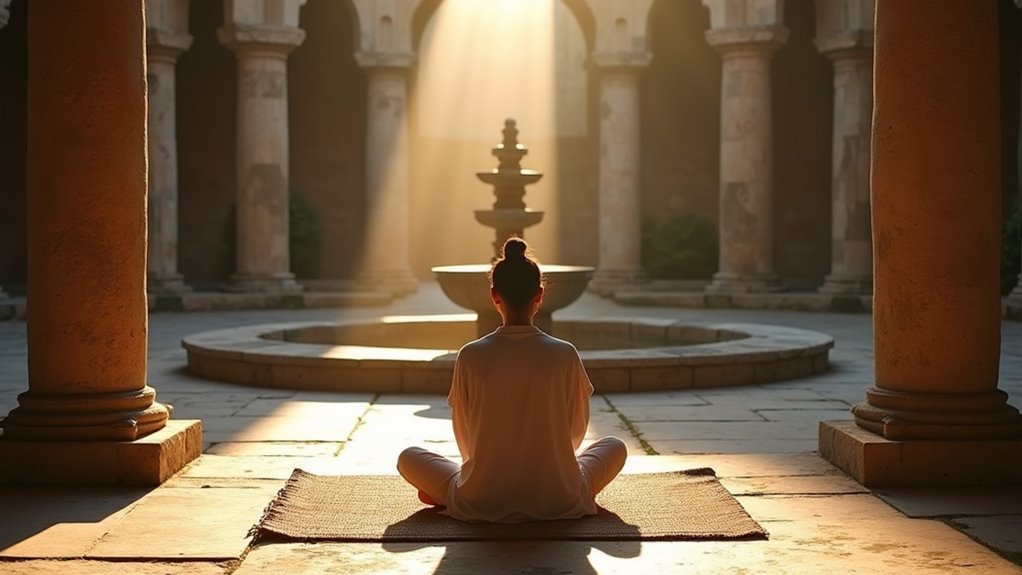

To meditate like a Stoic, start with a daily pause to breathe deeply and settle your mind. Observe your thoughts and feelings without judgment, recognizing that emotions are passing phenomena. Reflect on your reactions, aligning them with virtues like wisdom and courage, and remind yourself of what’s within your control. Practice consistently to build resilience, calmness, and moral clarity in daily life. If you explore these steps further, you’ll discover how to strengthen your inner virtues amidst external chaos.
Key Takeaways
- Begin with daily deep breathing to settle your mind and prepare for mindful observation.
- Observe your thoughts and emotions without judgment, recognizing them as passing phenomena.
- Focus on what is within your control—your responses and virtues—rather than external events.
- Reflect on your reactions, aligning them with virtues like wisdom, courage, justice, and temperance.
- Incorporate consistent meditation into daily life to cultivate clarity, moral integrity, and emotional resilience.

Have you ever wondered how Stoics managed to maintain calm and clarity in the face of life’s chaos? The secret lies in their practice of mindful detachment and virtue cultivation. When you meditate like a Stoic, you’re not trying to escape reality or suppress your feelings. Instead, you’re learning to observe your thoughts and emotions with a clear mind, understanding what’s within your control and what’s not. This mindful detachment doesn’t mean becoming indifferent; it means developing a healthy perspective that allows you to remain steady regardless of external circumstances. As you cultivate this skill, you’ll find yourself less reactive and more deliberate, able to face setbacks or difficulties with composure.
The foundation of Stoic meditation is recognizing that your peace depends on your attitude, not the events themselves. To start, take a moment each day to pause and breathe deeply. As you settle into stillness, focus on your intention to practice virtue and detach from fleeting passions. This isn’t about suppressing feelings but observing them without judgment. When negative thoughts arise—anger, envy, frustration—you acknowledge them without giving them power over you. This practice of observing your inner landscape helps you develop mindful detachment, allowing you to see sensations and emotions as passing phenomena rather than defining truths. Additionally, incorporating space for reflection can deepen your understanding of how your perceptions influence your emotional responses.
As you deepen your meditation, consider the role of virtue cultivation. The Stoics believed that living in accordance with virtues like wisdom, courage, justice, and temperance leads to true fulfillment. During your practice, reflect on how your reactions align with these virtues. For example, if you’re upset about something, ask yourself if your response embodies wisdom or justice. This internal dialogue sharpens your moral clarity and reinforces your commitment to virtue. Over time, your meditations serve as a mirror for your character, guiding you to act with integrity and resilience in daily life.
Incorporating these principles into your meditation routine transforms it into a tool for personal growth. With consistent practice, you start to distinguish between what’s within your power—your thoughts, judgments, and actions—and what’s outside it. This distinction, central to Stoic philosophy, becomes clearer through mindful detachment and virtue cultivation. As you learn to detach from external outcomes and focus on cultivating virtues, you’ll notice a shift: life’s chaos becomes less overwhelming, and your mind remains calm, clear, and purpose-driven. That’s how you meditate like a Stoic—by practicing awareness, restraint, and moral integrity in every moment.
Frequently Asked Questions
Can Anyone Practice Stoic Meditation Regardless of Beliefs?
You can practice Stoic meditation regardless of your beliefs since it’s a secular practice that emphasizes self-awareness and rational reflection. It’s highly adaptable and doesn’t require religious commitment, making it compatible with various spiritual or non-spiritual perspectives. By focusing on inner resilience and virtue, you can incorporate Stoic techniques into your routine without conflicting with religious beliefs, making it accessible and beneficial for everyone seeking mental clarity and emotional strength.
How Long Should a Typical Stoic Meditation Session Last?
A typical stoic meditation session lasts about 10 to 20 minutes, following simple duration guidelines that suit beginners and experienced practitioners alike. You should structure your session with focused reflection, such as contemplating virtues or preparing for challenges. Keep it consistent, and adjust the duration based on how comfortable you feel. This way, you develop mindfulness gradually, integrating stoic principles into your daily life without feeling overwhelmed.
Are There Specific Stoic Texts to Guide Meditation Practice?
You might wonder if there are specific Stoic texts to guide your meditation practice. While Stoic writings like Marcus Aurelius’s *Meditations* and Epictetus’s *Discourses* offer wisdom on mindfulness and self-control, they aren’t traditional meditation guides. Instead, they serve as philosophical texts that inspire reflective thought. To deepen your practice, consider using these texts alongside modern meditation guides inspired by Stoic principles to cultivate mindfulness effectively.
How Does Stoic Meditation Differ From Modern Mindfulness?
You might notice that Stoic meditation, rooted in ancient philosophical texts, emphasizes rational reflection and acceptance of fate, contrasting with modern mindfulness’s focus on present-moment awareness and non-judgment. Historically, Stoics used meditation to strengthen virtue and resilience, whereas today’s practice aims to reduce stress and enhance mental clarity. The key philosophical difference lies in Stoic acceptance of external events and internal discipline, unlike mindfulness’s emphasis on observing thoughts without attachment.
What Are Common Challenges When Starting Stoic Meditation?
When starting stoic meditation, you might face common challenges like mind wandering and emotional resilience. You may struggle to keep focus, drift into distractions, or find it hard to manage emotional reactions. These hurdles test your patience and discipline. However, by practicing consistently, you strengthen your mind’s resilience and improve your focus, transforming obstacles into opportunities to develop calmness, clarity, and inner strength—key pillars of stoic mindfulness.
Conclusion
Remember, meditation isn’t about perfection or escaping life’s challenges. It’s about facing them with calm clarity, just as the Stoics did. Even if your mind wanders or you feel distracted, keep practicing. You’re strengthening your resilience and inner peace with each session. Don’t let self-doubt hold you back—every moment you dedicate to mindfulness is a step toward a stronger, more centered you. Embrace the journey; growth begins with a single breath.