TL;DR
Spiritual meditation candles are candles people use as a visual focus, ritual marker, or meaningful part of a reflective practice. Choose one based on personal preference or the teachings of a tradition you follow, and treat claims about healing or guaranteed spiritual effects as beliefs rather than established facts. A candle is optional; if you use one, follow its safety instructions or choose a flameless alternative.
The room is quiet, your phone is face down, and a small flame wavers on the table. You watch it settle, take a breath, and let the day become a little less loud. For some people, that candle marks the start of meditation; for others, it is simply a warm point to rest their gaze.

Turn your quiet moments into listening time
- Thousands of audiobooks, podcasts and originals
- Listen on your phone, tablet or Echo — also offline
- Cancel anytime
Spiritual meditation candles are candles people use to help shape a reflective or sacred atmosphere. They can be plain or scented, chosen for color, symbolism, or personal meaning. This guide explains what they are, how people use them, and what to check before bringing one into your practice.
You will also find practical ways to choose a candle, make room for scent sensitivities, and keep an open flame safely. A candle can support a ritual that matters to you, but it is optional, and no color or fragrance guarantees calm, healing, or a particular spiritual outcome.
A spiritual meditation candle can act as a visual focus or ritual marker, but meditation does not require one.
Choose color based on your own meaning or the guidance of a tradition; common color associations are not universal rules.
Scent is personal. Unscented or flameless options may suit you better if fragrance or flame is uncomfortable.
Check ingredient and safety details rather than treating labels such as “natural” or “clean-burning” as proof of health benefits.
Use an open flame on a stable, heat-resistant surface, keep it away from children, pets, and flammable materials, and never leave it unattended.
What a meditation candle can add to your practice
A spiritual meditation candle is a candle you use as a visual focus, a marker for a ritual, or a personally meaningful part of contemplation. It may be a plain tea light or a scented candle in a glass jar; its meaning comes from your practice, preferences, or tradition. The candle is optional, and it does not guarantee a spiritual or emotional result.
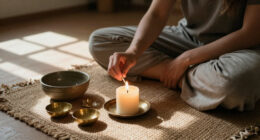
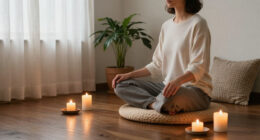
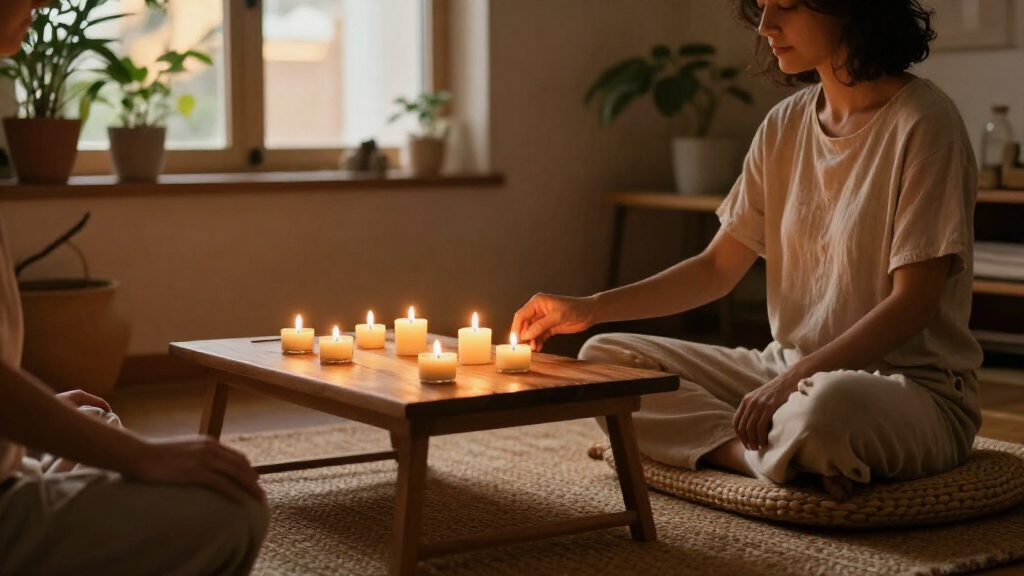
One simple use is to light a candle at the start of a quiet practice, then sit and follow your breath. The small flame gives your eyes one place to rest while you notice your breathing. That steady point can make it easier to begin when attention feels scattered, because it gives the practice a visible starting cue. Over time, repeating the same gesture may help you remember to pause; the cue supports a habit, but it does not do the work of meditation for you. If you prefer not to watch a flame, you can close your eyes, listen to a fan, or sit in daylight instead. The practice is yours; the candle is a possible aid, not a requirement.
For example, imagine you come home after a busy day and keep carrying a list of unfinished tasks in your head. Lighting a candle may help you mark five minutes as a pause before you begin your evening. The glow does not solve the tasks, but the repeated gesture can remind you to stop and take a breath. Some people also use this moment for prayer or intention-setting, guided by their own beliefs. The distinction matters: a ritual can give shape to what you choose to do, while its meaning and any spiritual interpretation remain personal.
Candle rituals appear in many spiritual and religious settings, and their meanings differ. If you are drawing from a specific tradition, learn its practices from informed sources instead of assuming a product description speaks for everyone. A quiet, personal ritual and a formal religious practice are not automatically the same thing. Knowing which one you are taking part in helps you avoid treating a symbol as interchangeable across communities, and lets you decide whether a simple candle suits your own practice.
Products Worth Considering

Garmin Forerunner 265S Running Smartwatch, 42mm, Whitestone/Neo Tropic

Levoit Vital 200S-P Smart Air Purifier for Large Rooms (up to 1875 ft²)

Therabody Theragun Mini Plus Portable Massage Gun with Heat
As an affiliate, we earn on qualifying purchases.
Choose a candle color that has meaning for you
Spiritual meditation candles come in many colors, but no color has one fixed meaning across every culture or tradition. White is often linked with peace or clarity, blue with calm, green with growth or abundance, red with vitality or love, and purple with spiritual reflection in some contemporary settings. Treat these as common associations, not universal rules. A color can remind you of an intention because you or your community has attached meaning to it; the same shade may carry a different meaning elsewhere.
Start with a meaning that feels relevant to your practice. If you want a reminder to slow down, a blue candle might suit you because you personally connect blue with a still lake or evening sky. If your own tradition uses a different color system, follow that context. The color can act like a bookmark for an intention; it cannot make the intention come true by itself. This keeps the choice useful without turning a symbolic prompt into a substitute for the choices and actions your intention may call for.
For instance, you might choose a green candle for a weekly moment of reflection about a new project. Each time you see it, you can ask yourself what small step you took that week. That gives the object a practical role without turning a symbolic association into a promise of success or abundance. If green instead has a different meaning in your tradition or experience, that context should guide your choice.
If you are choosing between colors, ask what you want the candle to remind you of, and whether that association comes from your own experience, a tradition you follow, or product marketing. Those sources are not interchangeable. A seller may offer a neat color-to-outcome chart, but you do not need to buy a particular color to meditate or to make your practice meaningful. Recognizing the source of an association helps you decide whether it reflects a belief you actually hold or simply a sales suggestion.
Pick a scent—or skip fragrance if it distracts you
There is no universally best meditation candle scent; the right choice is the one that feels pleasant and does not distract or irritate you. Lavender, frankincense, and sandalwood are popular in meditation products, but scent preferences are personal. An unscented candle is a straightforward option if fragrance gets in the way. Because scent can become part of the atmosphere you associate with a routine, a fragrance you enjoy may make that routine feel familiar; the same association can become distracting if the smell is too strong or unpleasant.
Notice how a fragrance affects you before using it during a longer practice. A scent that smells soft in a shop may feel strong in a small room, especially after burning for a while. People with asthma, migraines, allergies, or fragrance sensitivity may find scented candles uncomfortable. If that applies to you, consider an unscented or flameless candle, and follow advice from your health professional. Choosing less fragrance may mean giving up one sensory cue, but it can make the space more comfortable and easier to share with others.
For example, you might enjoy a single sniff of lavender on a store tester but find a scented jar overwhelming after ten minutes in a closed bedroom. Try a brief session in a well-ventilated room, and stop using it if you notice irritation or discomfort. You do not need fragrance to create a reflective setting. Starting with a short trial also helps you learn how the scent behaves in your actual space, rather than relying on how it seemed in a shop.
When comparing products, look beyond a label that says “natural” or “clean-burning.” These phrases may not tell you exactly which wax, fragrance, or wick the candle contains, and they do not prove a health benefit. Check the ingredient and safety information the maker provides. Think about the room, your sensitivities, and the people or animals who share the space before choosing a scent. A candle that smells pleasant to one person can affect a shared room differently for someone else, so comfort in the space is part of the choice.
Use a simple routine to give your candle a clear role
To use a meditation candle, decide what role it will play, set it up safely, and start a short practice with a comfortable focus. A candle can mark the beginning of reflection, prayer, or breath awareness; you do not need to perform a special ritual or burn it for a prescribed length of time. Keep the process easy to repeat. A routine with a clear beginning and end can help you set aside a few minutes without making the candle itself the measure of whether the practice went well.
- Choose your focus. Decide whether you will follow your breath, sit quietly, pray, or watch the flame from a comfortable distance.
- Prepare the space. Put the candle on a stable, heat-resistant surface, away from drafts and flammable items. Keep children and pets away.
- Set a modest intention. For example, “I will take five quiet minutes,” rather than expecting the candle to deliver a particular outcome.
- Begin gently. Light it according to the maker’s instructions, then sit comfortably. If watching the flame strains your eyes or feels distracting, shift your attention to your breath or another focus.
- Close safely. Extinguish the flame before you leave the room or go to sleep. Never leave a burning candle unattended.
Picture a five-minute pause before dinner: you place a candle on a cleared kitchen table, take a few slow breaths, and then put it out before cooking. That small routine gives the candle a clear beginning and end. There is no required burn time for meditation; the manufacturer’s instructions and your attention to safety should guide how long it burns. A shorter practice can still serve its purpose, and stopping to attend to the flame is part of using it responsibly.
Some people use flame-gazing, sometimes called trataka, as a concentration practice. If you try it, keep a comfortable distance and avoid straining your eyes. If you have relevant eye or neurological concerns, choose another focus or seek professional advice about what is suitable for you. A battery-operated candle can provide a point of light without an open flame. This is a practical tradeoff: you keep a visual cue while removing flame-related risks, though the light may not feel like the same ritual object to you.
Read candle labels without relying on wellness promises
A candle label can help you compare materials, but words like “natural,” “clean-burning,” and “non-toxic” do not, on their own, establish a health benefit. Candles may be made with paraffin, soy, beeswax, coconut wax, or blends, and they may use cotton or wooden wicks. Read the available ingredient and safety details instead of treating one material as automatically best. A clear label helps you understand what you are buying; it cannot establish that burning the candle will improve health or create a particular spiritual effect.
Wax type is only one part of the product. The wick, fragrance, how the candle is used, the room’s ventilation, and the maker’s instructions all matter to your choice. For instance, a candle marketed as plant-based may still have a strong fragrance that bothers you. Someone else might prefer a lightly scented candle but avoid an open flame entirely. Looking at the product as a whole helps you weigh its material, scent, and use in your actual setting, instead of letting one appealing label settle the decision.
Recent consumer interest has brought more attention to plant-based waxes, reusable vessels, simpler ingredient disclosures, and candles marketed for particular moods or rituals. Social media has also popularized intention candles and short candlelit meditation routines. These are market and cultural trends; they are not evidence that a specific wax, color, scent, or ritual creates spiritual, therapeutic, or health outcomes. Understanding that distinction lets you enjoy a trend or product aesthetic while deciding for yourself whether its practical features and symbolism fit your needs.
When you shop, look for clear product details and safety instructions, then weigh them against your needs. If you are comparing two jars, the one with the most dramatic promise is not necessarily the one that suits your room or practice. A simple candle—or no candle at all—can serve just as well as a more elaborate product. The useful question is whether the candle’s actual features support the role you have in mind, not whether its claims make the ritual sound more powerful.
Keep the ritual respectful, personal, and safe
A candle ritual works best when you understand what it means to you and use it with respect for the space and tradition around it. Candles play roles in many spiritual and religious practices, but their meanings and protocols differ. If you join a practice from a tradition that is not yours, learn its guidance from people who know it rather than borrowing a symbol based only on a shop listing. That context matters because using a familiar-looking object does not necessarily mean you understand the practice it represents.
Claims that candles cleanse energy or manifest intentions belong to personal beliefs or particular spiritual practices. People may find meaning in those rituals, but the claims are not established as scientific effects of wax or flame. You can describe your own experience honestly: “Lighting this candle reminds me to pray,” or “This ritual helps me pause.” That leaves space for belief without promising the same result for everyone, and it distinguishes a meaningful personal experience from a claim that could be presented as a guaranteed effect.
Keep the physical side simple. Set the candle on a stable, heat-resistant surface, away from curtains, paper, and other flammable materials. Keep it out of reach of children and pets, and never leave it burning unattended. Extinguish it before you leave the room or sleep, and follow the product’s specific directions. These steps matter because a ritual can draw your attention inward; a safe setup reduces the chance that the quiet moment leaves a preventable hazard behind.
If a flame or fragrance does not fit your home, a battery-operated candle or another visual focus can keep the ritual’s shape without burning wax. For example, someone with a curious cat might choose a flameless light on a high shelf, or skip the light and use a smooth stone as a reminder to breathe. The meaningful part can be the pause you make, not the object you buy. Choosing an alternative preserves the cue while adapting the practice to the people, animals, and space around you.
Frequently Asked Questions
What is a spiritual meditation candle?
It is a candle used as a visual focus, a ritual marker, or a meaningful part of a reflective practice. People may choose one for its color, scent, or connection to personal beliefs or a spiritual tradition.
Do meditation candles actually work?
A candle may help some people create a familiar setting or give their attention a visual place to rest. Experiences differ, and the candle is optional; it does not guarantee a spiritual, emotional, or healing result.
Which candle color should I choose?
Choose a color that feels meaningful to you or fits the guidance of a tradition you follow. Common contemporary associations include white with peace or clarity and blue with calm, but color meanings vary and there is no required choice.
Which scents are best for meditation?
There is no scent that works best for everyone. Choose a fragrance you find comfortable, or pick an unscented candle if fragrance distracts or irritates you.
Can I meditate by looking at a candle flame?
Some people use flame-gazing, sometimes called trataka, as a concentration practice. Sit at a comfortable distance and avoid straining your eyes; if you have relevant eye or neurological concerns, use another focus or ask a professional what suits you.
How long should I burn a meditation candle?
There is no required burn time for meditation. Follow the candle maker’s instructions, stay with the candle while it burns, and extinguish it before leaving or sleeping. A battery-operated candle is another option.
Conclusion
Choose a candle for the meaning, scent, or quiet visual focus it offers you—not for a promise on its label. Keep the practice grounded in your own beliefs, respect the traditions you draw from, and choose a flameless or unscented option if that fits your needs better.
A small flame can mark five quiet minutes, then disappear when you put it out. The pause is what you carry with you.