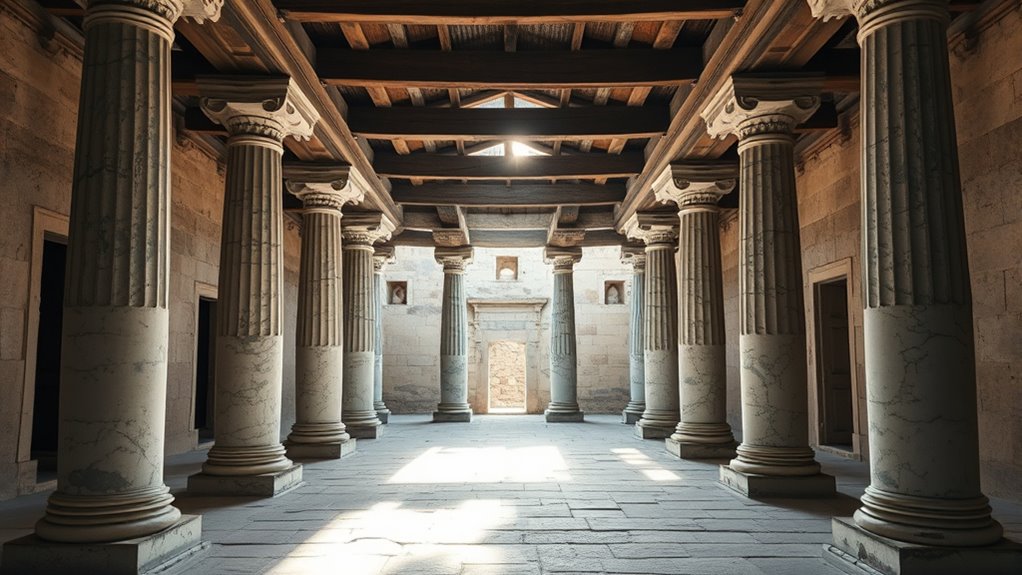

The Stoic school at Stoa Poikile was a key hub for ancient Athens’ philosophical ideas, emphasizing virtues like wisdom, courage, and self-control. It shaped how we think about ethics, resilience, and inner peace. These teachings remain influential today, inspiring modern therapies and personal growth methods. By focusing on rationality and virtue, the Stoics teach us to navigate challenges with calm and integrity. Discover how this ancient philosophy can still guide your life.
Key Takeaways
- The Stoa Poikile was a central gathering place for early Stoic philosophers in ancient Athens.
- It served as the birthplace of Stoic ethics, emphasizing virtue, rationality, and self-control.
- Key Stoic ideas developed there include distinguishing controllable and uncontrollable factors and cultivating resilience.
- The teachings from the Stoa significantly influenced later philosophy, psychology, and modern self-help movements.
- Its legacy continues to shape contemporary views on morality, ethical decision-making, and personal resilience.

The Stoic School at Stoa Poikile was a pivotal center for philosophical thought in ancient Athens, where thinkers gathered to explore the virtues of reason, self-control, and resilience. You might not realize it, but the ideas developed here still resonate today, shaping how we think about virtue, morality, and how to steer life’s challenges. Central to Stoic philosophy was Stoic ethics, which teaches you to distinguish between what you can control and what you cannot. This practical approach encourages you to focus your energy on your character and reactions, rather than external events. By cultivating virtues like wisdom, courage, justice, and temperance, you learn to accept life’s ups and downs with equanimity. These principles aren’t just abstract theories; they’re tools you can apply daily to maintain inner peace and moral integrity, regardless of circumstances. Furthermore, the Stoics emphasized the importance of halal ethics, which underscores the significance of moral purity and adherence to principles in daily life, highlighting the relevance of ethical consistency across different cultural contexts.
The influence of Stoic ethics extends far beyond the ancient world. When you study modern philosophy, you’ll notice echoes of Stoic ideas in existentialism, cognitive-behavioral therapy, and even contemporary self-help movements. The Stoics emphasized rationality and self-control as means to achieve tranquility, concepts that underpin many modern psychological practices aimed at managing emotions and reducing stress. Their focus on resilience—bouncing back from adversity—has become a cornerstone of personal development today. You’re encouraged to view obstacles as opportunities for growth, adopting a mindset that emphasizes mastery over your responses rather than external conditions. This mindset aligns with many principles in today’s mental health strategies, making Stoic ethics highly relevant.
Furthermore, the influence of Stoic thought is evident in how you approach ethical dilemmas and decision-making. The Stoics believed that virtue is the highest good and that living ethically aligns you with nature’s rational order. You’re urged to act justly and wisely, cultivating an inner moral compass that guides you through complex situations. This ethic of virtue influences contemporary discussions about moral responsibility and integrity, encouraging you to live authentically and with purpose. The Stoic emphasis on reason as a guiding principle helps you develop clarity and sound judgment, skills that remain essential in modern leadership and ethical debates. Overall, the teachings from the Stoa Poikile continue to shape how you understand morality and resilience, demonstrating that ancient philosophy still offers valuable insights for steering today’s world.
Frequently Asked Questions
How Did Stoicism Influence Modern Cognitive Behavioral Therapy?
You can see how Stoicism influences modern cognitive behavioral therapy through its emphasis on mindfulness practices and emotional regulation. By adopting Stoic techniques, you learn to observe your thoughts without judgment, helping you manage emotional responses better. This approach encourages you to focus on what you can control, fostering resilience and calmness, much like CBT’s goal of changing negative thought patterns to improve mental health.
Which Famous Philosophers Were Students of the Stoa Poikile?
You might be surprised to learn that some of history’s most renowned ancient philosophers, like Epictetus and Zeno, studied at the Stoa Poikile, immersing themselves in Stoic ethics. These thinkers, with their focus on virtue and resilience, shaped modern ideas about personal conduct. Their teachings, rooted in ancient philosophy, continue to influence contemporary self-improvement and ethical discussions, bridging the past with the present in a powerful, timeless dialogue.
What Events Led to the Decline of the Stoic School at Athens?
You should know that the decline of the Stoic school at Athens was driven by Roman political upheaval and the broader decline of philosophical schools. As Rome’s influence grew, traditional Greek philosophies lost prominence, and internal disagreements within Stoicism surfaced. These factors, combined with the rise of other philosophies like Epicureanism and skepticism, weakened the school’s standing, leading to its eventual decline in Athens.
How Did Stoic Teachings Spread Beyond Greece Into Rome?
Like a spark igniting a flame, Stoic teachings spread from Greece to Rome through trade routes and philosophical exchanges. You see, Roman thinkers like Seneca and Marcus Aurelius embraced Stoicism, translating ideas into daily life. These exchanges, fueled by merchants and scholars, transformed Stoic philosophy into a guiding light for Roman citizens, ensuring its influence endured beyond Greece’s borders and shaped Western thought for centuries.
Are There Surviving Writings Directly From the Original Stoic Teachers?
You’ll find that there are very few surviving writings directly from the original Stoic teachers. Most of what we know comes from ancient manuscripts that preserve their ideas through later translations and compilations. Philosophical preservation played a vital role, as these texts were copied and studied by later thinkers, helping Stoic teachings endure despite the loss of many original manuscripts.
Conclusion
So, as you see, the Stoic School at Stoa Poikile isn’t just a tiny chapter in history—it’s the backbone of resilience and wisdom that still shapes us today. Its ideas have traveled through centuries, like an unstoppable force of nature, guiding countless lives. Remember, the teachings from that ancient porch are so powerful, they could probably tame a wild lion—if only we’d listen. Embrace Stoicism, and watch your spirit grow unbreakable!