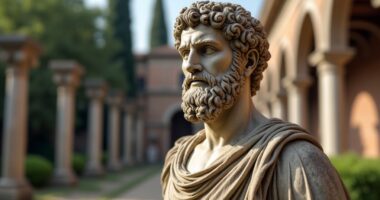

Hierocles’ Circle of Concern illustrates how your moral responsibility expands from yourself to all humanity through interconnected layers. Starting with self-care, it extends outward to family, friends, community, and eventually to everyone worldwide. This model shows how your sense of moral duty grows as you recognize our shared reason and virtue. If you explore further, you’ll discover how this framework guides you to act ethically on a global scale, fostering compassion for all.
Key Takeaways
- Hierocles’ Circle of Concern illustrates moral concern expanding from self to all humanity.
- The innermost circle focuses on oneself, with subsequent circles including family, friends, and broader society.
- The outermost circle encompasses all humans, emphasizing universal moral responsibility.
- The circles are interconnected, highlighting moral unity and shared reason across all levels.
- This model encourages expanding compassion and ethical duties from personal to global contexts.

Stoic cosmopolitanism presents a compelling vision of global unity rooted in the ancient philosophy of Stoicism. At its core, this perspective emphasizes that all humans are part of a single moral community, transcending national borders, race, or social status. You’re encouraged to see yourself as a citizen of the world, bound by shared reason and virtue. This idea of moral universalism asserts that moral duties extend beyond local or national allegiances, forming the foundation of a genuine global ethics. Instead of limiting your concern to your immediate community, you adopt a broader view—recognizing that everyone, regardless of their background, deserves your respect and compassion. This isn’t just an abstract principle; it’s a call to action that aligns with the Stoic belief in universal reason as the guiding force for moral behavior.
As you embrace Stoic cosmopolitanism, you start to see your responsibilities in a wider context. Hierocles’ circle of concern vividly illustrates this expansion: at the center is yourself, but it quickly extends outward to family, friends, community, and eventually to all humanity. Each circle isn’t separate or exclusive but interconnected, reinforcing that your moral duties naturally grow as your understanding deepens. You’re encouraged to widen your circle of concern, recognizing the interconnectedness of all people. This view fosters a sense of shared destiny and moral obligation that motivates you to act ethically on a global scale. When you see the world through this lens, your actions are guided not only by personal interest but also by a sense of universal responsibility.
Frequently Asked Questions
How Does Hierocles’ Circle Compare to Modern Global Ethics?
Hierocles’ circle emphasizes moral expansion and ethical inclusivity by gradually widening your concern from yourself to all humanity. Compared to modern global ethics, it promotes a sense of interconnectedness and shared responsibility, encouraging you to extend compassion beyond local or national boundaries. This approach aligns with contemporary efforts to foster global solidarity, emphasizing that your moral circle should continually expand to include everyone, fostering a more inclusive and compassionate world.
What Are Practical Steps to Expand One’s Circle of Concern?
Imagine your circle of concern as a garden that needs constant tending. To expand it, you actively practice empathy development by listening deeply and imagining others’ perspectives. Engage in community activities, volunteer, or join groups beyond your usual circle. Each connection plants new seeds of understanding, helping your concern grow outward like branches reaching for the sun, fostering a broader sense of shared humanity and compassion in your daily life.
How Does Stoic Cosmopolitanism Address Contemporary Political Issues?
You can approach contemporary political issues through stoic cosmopolitanism by embracing universal compassion and recognizing your global responsibility. By understanding that all humans are part of a single community, you actively promote empathy and justice beyond national borders. This mindset encourages you to support policies and actions that foster equality, peace, and sustainability, aligning your personal values with broader efforts to address global challenges with compassion and a sense of shared responsibility.
Can Hierocles’ Concept Be Applied to Environmental Concerns?
Yes, you can apply Hierocles’ circle of concern to environmental issues by recognizing your environmental responsibility within a broader network of global interconnectedness. As you expand your circle outward, you understand that your actions impact others and the planet. This perspective encourages you to act responsibly, prioritize sustainability, and foster a sense of shared duty, ultimately promoting a more compassionate and interconnected approach to addressing environmental challenges.
What Are Criticisms of Stoic Cosmopolitanism’s Applicability Today?
Can we truly embrace universal compassion when cultural relativism challenges our views? Critics argue that stoic cosmopolitanism faces practical limitations, making it difficult to apply consistently across diverse cultures. They question whether moral obligations can be truly global or are constrained by local traditions. These criticisms highlight that, despite noble ideals, implementing such a philosophy today may overlook complex social realities and cultural differences.
Conclusion
Imagine standing at the edge of a vast circle, your concern expanding from your immediate surroundings to all of humanity. Like Hierocles’ circle, your compassion grows outward, connecting you to strangers across borders. While the world’s chaos may seem distant, your reason guides you to see everyone as part of a shared cosmos. Embrace this unity, for in caring beyond yourself, you find a profound sense of purpose and harmony within the endless circle of our common humanity.