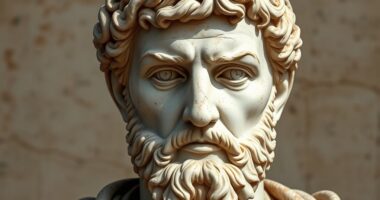

Chrysippus, often overlooked, was the true founder of Stoic logic, transforming philosophy into a systematic discipline. He emphasized logical rigor, developing tools to analyze arguments and uncover contradictions. His work laid the foundation for modern logic, critical thinking, and formal reasoning systems. By linking logical analysis to understanding reality and morality, he shaped a disciplined approach still influential today. Discovering his role reveals how ancient methods influence the way you evaluate ideas now.
Key Takeaways
- Chrysippus was the primary developer of Stoic logic, establishing its foundational principles and methods.
- He introduced formal techniques to analyze arguments, detect contradictions, and evaluate reasoning rigorously.
- His work shifted Stoic philosophy from vague speculation to a systematic, analytical discipline.
- Chrysippus’s contributions laid the groundwork for modern logic, critical thinking, and formal reasoning systems.
- His legacy significantly influenced the evolution of philosophical and scientific inquiry beyond Stoicism.

Many people overlook Chrysippus, yet he was the true architect behind Stoic logic, shaping ideas that still influence philosophy today. If you want to understand the foundations of logical reasoning, you need to recognize his contribution. Chrysippus emphasized logical rigor, developing methods to analyze arguments and uncover contradictions. His work transformed Stoic philosophy into a systematic discipline grounded in clear, consistent reasoning. Unlike earlier thinkers, who often relied on vague concepts or intuitive thought, Chrysippus introduced formal approaches that allowed for precise evaluation of truth and falsehood. His emphasis on logical analysis provided the tools necessary for distinguishing valid reasoning from fallacious arguments.
Chrysippus revolutionized Stoic logic with formal methods for analyzing arguments and uncovering contradictions.
By applying strict logical principles, he created tools that help distinguish between valid and invalid arguments. This commitment to logical rigor means that his influence extends far beyond Stoicism itself; it informs modern logic, critical thinking, and even computer science. You can see his impact in how we structure arguments today, ensuring clarity and coherence. Chrysippus didn’t just settle for vague philosophical musings—he sought to establish a universal method for reasoning. His work laid the groundwork for formal logic systems that persist in contemporary philosophy and mathematics. Because of him, philosophy shifted from speculative to analytical, emphasizing the importance of reasoning processes that withstand scrutiny.
His philosophical influence is profound because he connected logic directly to ethical and metaphysical questions. You’ll find that Chrysippus believed that understanding the nature of reality and morality depended on logical analysis. His insistence on logical rigor meant that he viewed philosophy as a practical tool, helping you navigate life with clearer insight. His systematic approach provided a framework for evaluating beliefs and theories, making philosophy a more disciplined pursuit. Chrysippus also argued that knowledge could be achieved through reason, not just tradition or emotion, which reinforced the importance of clear thinking in everyday life. This approach influenced later Stoics and shaped the broader trajectory of Western philosophy.
In essence, Chrysippus’s contribution wasn’t mere speculation but a structured, disciplined method that prioritized clarity and consistency. His ideas set the stage for future generations to pursue truth through logical analysis. Without his pioneering work, the development of formal logic and analytical philosophy might have been delayed or taken a different path. Recognize that his legacy endures because he prioritized logical rigor and saw philosophy as a rigorous pursuit of understanding. As you explore philosophical reasoning today, remember that Chrysippus’s influence remains woven into the fabric of critical thinking, shaping how we analyze and interpret ideas across centuries.
Top picks for "chrysippu forgotten architect"
Open Amazon search results for this keyword.
As an affiliate, we earn on qualifying purchases.
Frequently Asked Questions
How Did Chrysippus Influence Modern Logical Theory?
You see, Chrysippus essential influenced modern logical theory by developing formal symbolism to clarify complex ideas. He tackled logical paradoxes, showing how to resolve contradictions and improve reasoning. His work laid the groundwork for symbolic logic, shaping how we analyze arguments today. By pioneering these methods, you can trace much of contemporary logic’s foundation back to his innovative approaches, making him a vital figure in logical history.
What Were Chrysippus’s Main Philosophical Disagreements With Other Stoics?
Imagine a tightrope walk between conflicting beliefs—you face Chrysippus and other Stoics, each holding different shadows of truth. He sharply disagreed on Stoic divisions, emphasizing a systematic, logical approach, while others prioritized moral virtue and emotion. His logical disagreements centered on how to structure knowledge, advocating for rigorous reasoning. You see his insistence on clarity as a bridge, helping you navigate the complex landscape of Stoic thought with precision.
Did Chrysippus Write Any Surviving Texts Himself?
You’ll find that Chrysippus didn’t leave behind any surviving texts himself, but his ideas survive through ancient manuscripts and philosophical citations by later writers. Scholars piece together his contributions by analyzing these references, revealing his influence on Stoic logic and ethics. While he didn’t write directly for us today, his legacy persists through these ancient texts, making him a essential figure in Stoic philosophy’s development.
How Was Chrysippus Viewed by His Contemporaries?
You’d find that Chrysippus was highly regarded by his contemporaries, with many praising his logical skills and philosophical insights. The public reception was positive, as people valued his contributions to Stoic philosophy. Peer opinions often regarded him as a foundational figure, shaping the development of Stoicism. His reputation grew through his extensive writings and debates, making him a respected and influential thinker in ancient Greece.
Are There Any Notable Anecdotes About Chrysippus’s Personal Life?
You’ll find few personal anecdotes about Chrysippus, but what’s known highlights his character traits. He was dedicated, disciplined, and known for his sharp wit. Once, he reportedly fell asleep in a lecture, showing his human side. His unwavering commitment to philosophy and his resilience in debates reveal a man deeply passionate and determined. These stories, though sparse, give you glimpses of a philosopher who embodied Stoic virtues.
Conclusion
Just like a master builder who quietly shapes a grand structure, Chrysippus laid the foundations of Stoic logic without seeking the spotlight. His work forms the sturdy framework you rely on today, often overlooked but essential. Recognize him as the unseen architect behind your understanding of reason and argument. Without his silent guidance, the edifice of Stoic philosophy might crumble. Remember, it’s sometimes the quiet builders who leave the most lasting legacy.