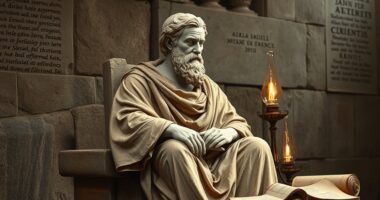
The Stoics teach that while fate determines many aspects of your life through a divine order, your moral responsibility lies in how you respond to those circumstances. You can’t control what happens, but you do control your reactions, judgments, and choices. They emphasize that true freedom comes from accepting what’s beyond your influence and focusing on your internal responses. To better understand how their view balances destiny and personal agency, keep exploring these ideas further.
Key Takeaways
- Stoics believed everything occurs according to a divine rational order called Logos, implying a deterministic universe.
- They argued that external events are beyond control, but our responses and judgments are within personal power.
- Moral responsibility remains vital; virtue is cultivated through wise choices despite predetermined circumstances.
- Acceptance of fate aligns with living in harmony with nature, emphasizing internal responses over external control.
- True freedom, for Stoics, lies in controlling one’s reactions and maintaining virtue regardless of destiny.

Have you ever wondered whether your choices truly shape your future or if everything is already predetermined? This question lies at the heart of the debate between fate and free will, a topic that has intrigued thinkers for centuries. The Stoics, ancient Greek philosophers, offered a unique perspective by integrating ideas of determinism and morality into their understanding of destiny. They believed that everything happens according to a divine rational order, which they called the Logos. In this view, the universe is governed by natural laws, and events are predetermined in a grand, orderly fashion. Yet, rather than seeing this as a negation of human agency, the Stoics emphasized personal responsibility within this framework. They argued that while external events may be beyond your control, your reactions and choices are entirely within your power. This distinction allows you to navigate life with a sense of moral agency, despite the deterministic nature of the universe.
The Stoics held that understanding the difference between what you can control and what you cannot is key to living a virtuous life. They believed that recognizing the limits of external circumstances aligns with a realistic view of determinism. But they also insisted that your internal responses—your thoughts, judgments, and actions—are your own. This is where personal responsibility comes into play. Even if destiny shapes the circumstances you face, it’s up to you to determine how you respond. That’s why they emphasized cultivating virtue, resilience, and wisdom—traits you can develop regardless of external forces. By doing so, you uphold your moral integrity and fulfill your role within the greater order of the cosmos. Understanding the concept of existential questioning can deepen your appreciation for the nuanced balance the Stoics sought to achieve.
This perspective offers a balanced approach. It acknowledges the influence of fate while affirming your moral agency. Instead of feeling powerless, you’re encouraged to focus on your character and choices. The Stoics believed that true freedom lies in accepting what’s beyond your control and dedicating yourself to what you can influence—your own thoughts and actions. This way, you can find peace in the knowledge that, even if the universe is deterministic, your personal responsibility remains intact. You are responsible for your virtue and for how you live in harmony with the natural order. In the end, understanding this balance can empower you to face life’s challenges with equanimity, knowing that your moral choices are your own, regardless of what fate may have in store.

Essential Oil Diffuser, 100ml Aromatherapy Diffuser, Mini Ultrasonic Diffuser for Essential Oil, Home, Office, Cool Mist Humidifier with 7 Led Light, Auto Shut-Off, White
Compact Aroma Hub: This 3.54" x 5.91" essential oil diffuser fits seamlessly into any space - home or...
As an affiliate, we earn on qualifying purchases.
Frequently Asked Questions
How Do Stoics Reconcile Personal Responsibility With Fate?
You might wonder how the Stoics reconcile determinism with agency and moral accountability. They believe that while fate shapes the universe, your responses are within your control. This view balances determinism and free will, emphasizing that your moral responsibility lies in how you choose to respond to circumstances. You’re accountable for your actions, even if external events are predetermined, because your character and choices define your virtue and integrity.
Did Stoics Believe Free Will Exists at All?
Like a ship steering through a storm, you might wonder if free will truly steers your course. The Stoics believed the determinism debate is nuanced: they saw some aspects of life as governed by fate, but they also thought free will exists as a kind of inner choice within that framework. They didn’t see free will as an illusion but as a necessary part of living virtuously amidst life’s inevitable course.
How Does Fate Influence Moral Decision-Making?
You might wonder how fate influences moral decision-making. The Stoics believe that determinism shapes our circumstances, but it doesn’t undermine morality. Fate guides the external world, while your virtue determines your response. By understanding fate and embracing your capacity for virtue, you can maintain moral integrity. Your choices, rooted in reason, align with nature’s order, showing that morality thrives despite fate’s influence.
Can Understanding Fate Lead to Greater Happiness?
You might find that understanding fate can lead to greater happiness by embracing determinism and practicing acceptance. When you accept what’s beyond your control, you cultivate contentment and reduce frustration. Recognizing that some events are predetermined helps you focus on your responses, fostering inner peace. This mindset aligns with Stoic principles, showing that accepting destiny can enhance your overall happiness and resilience in life’s uncertainties.
How Do Stoics Handle Unexpected Life Events?
When faced with unexpected life events, you should focus on what you can control, aligning with the Stoic approach to the determinism debate. They believe fate influences outcomes, but your emotions are within your power. By accepting destiny and maintaining inner calm, you can handle surprises better. This mindset helps you stay resilient, recognizing that your attitude shapes your experience, even amid unpredictable circumstances.

KinYiLO 300ML Essential Oil Diffuser, Quiet Aromatherapy Diffuser Mist Humidifier with 7 Colors Light, Auto-Off, 1H/3H/6H Timer, Ultrasonic Room Scent Diffuser for Home, Office, Brown (No Remote)
[ Stylish Home Decoration Diffuser ] : This uniquely designed, teardrop-shaped aromatherapy diffuser is the perfect accent piece...
As an affiliate, we earn on qualifying purchases.
Conclusion
Imagine standing in a swift river, feeling the current pull you along, yet still holding your paddle. The Stoics believed fate is the river’s flow—inevitable, shaping your journey—while free will is your paddle, guiding your way through. You can’t control the current, but you choose how to steer. Embrace both: flow with destiny, but steer your choices. That balance turns life’s chaos into a purposeful voyage.

Airversa Waterless Essential Oil Diffuser Starter Kit with 2x20mL Hotel Scent Fragrance Oil for Home Car Room Office, Battery Operated Mini Scent Air Machine Portable Diffuser, AN8Kit-C Black
Luxury Starter Kit with Curated Hotel Scents ✾ Elevate your space right out of the box with two...
As an affiliate, we earn on qualifying purchases.

HJTHJT 500ML Essential Oil Diffuser: Aroma Diffuser with Remote Control for Hotel Spa Yoga Room - Humidifiers for Bedroom with 14 Colors LED Night Light for Kids/Women Home Relaxation
Large Capacity Aroma Diffuser: 500 ML essential oil diffusers for home is wonderful for large rooms. This diffuser...
As an affiliate, we earn on qualifying purchases.