

Panaetius and Posidonius played crucial roles in shaping Stoicism’s progression to Rome by adapting Greek ideas to fit Roman social and political values. They shifted focus from abstract metaphysics to practical ethics, emphasizing duty, justice, and self-control for personal and societal harmony. Their work made Stoicism more accessible and relevant, inspiring later Roman thinkers like Seneca and Marcus Aurelius. To discover how their ideas influenced the Stoic tradition further, keep exploring their impact.
Key Takeaways
- Panaetius and Posidonius adapted Greek Stoicism to Roman social and political contexts, emphasizing practical ethics and civic duty.
- Panaetius shifted Stoicism focus from metaphysics to moral virtues like duty, justice, and self-control, making it more accessible for Romans.
- Posidonius expanded Stoicism with natural philosophy, integrating scientific inquiry and cosmology into the philosophical framework.
- Both philosophers transformed Stoicism into a pragmatic worldview, influencing Roman thinkers such as Seneca, Epictetus, and Marcus Aurelius.
- Their contributions facilitated the transition of Stoicism from Greek origins to a comprehensive, socially relevant Roman philosophy.
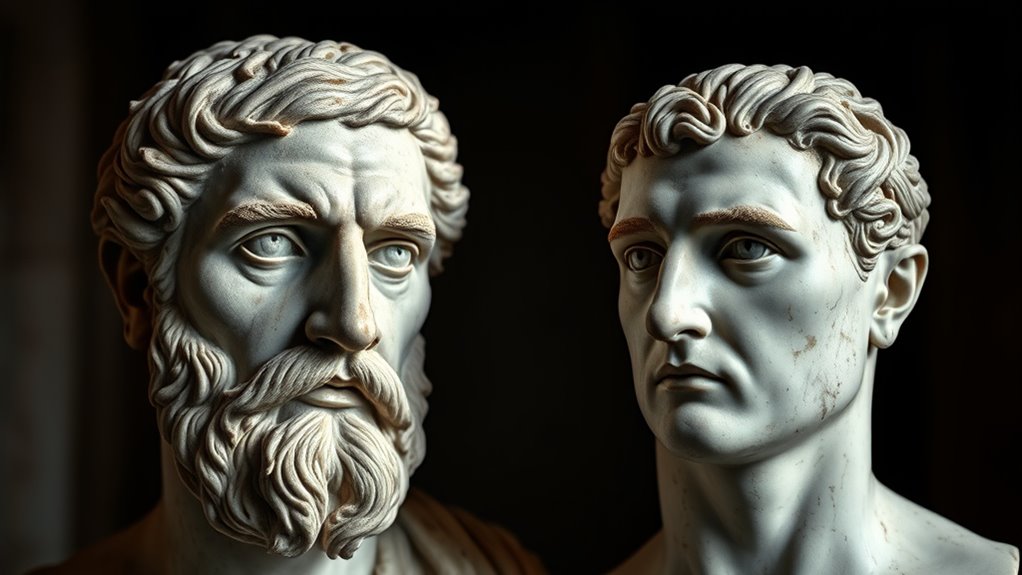
Stoicism, originally developed in Greece, found a new home and transformed profoundly when it was embraced by the Romans. As you explore this shift, you’ll notice how figures like Panaetius and Posidonius played pivotal roles in shaping the ethical developments of Roman Stoicism and extending its philosophical influence. These thinkers didn’t merely adopt Greek ideas; they adapted and expanded them to resonate with Roman values and societal structures. Their work marks a significant turning point, moving Stoicism from a primarily personal ethical system to a more complete worldview with social and political implications.
Roman thinkers like Panaetius and Posidonius adapted Greek Stoicism to fit Roman social values and politics.
Panaetius, in particular, was instrumental in bridging Greek philosophical traditions with Roman culture. He emphasized ethics grounded in practical virtue, focusing on how individuals could cultivate tranquility and moral character amidst everyday life. By doing so, he shifted the focus from abstract metaphysics to practical ethics, making Stoicism more accessible and relevant to Roman citizens. His teachings incorporated the idea that ethical behavior is essential for personal happiness and social harmony, reinforcing the importance of duty, justice, and self-control. This development not only enriched Stoic ethics but also influenced Roman ideas about civic responsibility, shaping how people thought about their roles within society. Additionally, his emphasis on practical virtue helped to make Stoic philosophy more applicable to daily life.
Posidonius further expanded upon Panaetius’s groundwork, injecting his own philosophical influence into Stoicism. He introduced a broader cosmological perspective, integrating Stoic ideas with Stoic natural philosophy and scientific inquiry. His efforts helped portray Stoicism as a complete philosophy that explained the universe while providing practical guidance for daily life. Posidonius’s emphasis on rational inquiry and understanding nature’s order reinforced the ethical developments by highlighting reason as central to human life and moral decision-making. His work encouraged Romans to see philosophy as a means to improve both their personal virtue and their understanding of the cosmos.
Together, Panaetius and Posidonius transformed Stoicism into a more pragmatic and influential philosophy. They made it relevant to Roman society by emphasizing ethical developments that prioritized moral virtue and social responsibility. Their philosophical influence extended beyond ethics, inspiring later Roman thinkers like Seneca, Epictetus, and Marcus Aurelius, who further integrated Stoic principles into their writings. As you trace this trajectory, you’ll see how these Roman adaptations helped Stoicism evolve from a Greek school of thought into a vital intellectual tradition that continues to inspire ideas about virtue, duty, and the good life today. This shift underscores how philosophical ideas adapt and thrive, shaping ethical landscapes across different cultures and eras.

Practical Stoicism: Exercises for Doing the Right Thing Right Now
As an affiliate, we earn on qualifying purchases.
As an affiliate, we earn on qualifying purchases.
Frequently Asked Questions
How Did Panaetius Influence Stoic Ethics?
You see, Panaetius influenced Stoic ethics by emphasizing the importance of moral duty and practical virtue. He believed that living virtuously involves fulfilling your moral duties to others and society, not just personal excellence. His focus on adapting virtue ethics to real-life situations helped shape a more flexible, duty-based approach to Stoicism, guiding you to act ethically amid everyday challenges and prioritize moral responsibility over theoretical ideals.
What Are Posidonius’s Contributions to Stoic Cosmology?
You see that Posidonius advanced Stoic cosmology by developing detailed models of the universe, emphasizing celestial harmony. He proposed that the cosmos operates like a divine, interconnected system where celestial bodies influence each other through rational laws. His work integrates physics, astronomy, and philosophy, helping you understand the universe as a rational, purposeful whole, where harmony among celestial bodies reflects divine order and natural law.
How Did Roman Culture Shape Stoic Philosophy?
Roman culture shaped Stoic philosophy through cultural assimilation and Roman customs, which you notice in their emphasis on practicality and duty. You find that Stoics adopted Roman values like discipline, civic responsibility, and respect for social hierarchy, making their ideas more relevant to Roman society. This blending helped Stoicism flourish, making it accessible and applicable to everyday Roman life, ultimately strengthening its influence across the empire.
Were Panaetius and Posidonius Politically Active?
Politically, Panaetius and Posidonius participated actively, advocating Stoic principles in Roman politics. They believed that personal virtue should influence public life, so they engaged in Roman political involvement, shaping societal standards. Their philosophical pursuits intertwined with civic duties, demonstrating that Stoic advocacy wasn’t just theoretical but practically powerful. By balancing personal integrity with public service, they showed how philosophy could serve society and promote moral progress.
How Did Stoicism Evolve After Posidonius?
After Posidonius, Stoicism evolves through greater adaptability and philosophical integration. You’ll see Stoic ideas blending with other schools, making the philosophy more practical and accessible. This adaptability helps you apply Stoic principles to everyday life, emphasizing emotional resilience and moral virtue. The focus shifts from strict logic to a more inclusive approach, allowing Stoicism to remain relevant as it incorporates diverse perspectives and responds to changing societal needs.

A Student's Guide to Philosophy: Philosophy (Guides to Major Disciplines)
As an affiliate, we earn on qualifying purchases.
As an affiliate, we earn on qualifying purchases.
Conclusion
You can see how Panaetius and Posidonius shaped Stoicism’s shift from Greece to Rome, making it more practical and accessible. Their ideas suggest that Stoicism wasn’t just philosophical theory but a way to navigate daily life. While some skeptics argue their influence was limited, evidence shows their teachings deeply integrated into Roman culture. This theory helps you understand how Stoicism evolved, proving it adaptable and relevant across different eras and societies.

My Daily Journal of Meditations Guided By The Stoics: A Daily Journal with Stoic Quotations on Living a Life of Virtue
As an affiliate, we earn on qualifying purchases.
As an affiliate, we earn on qualifying purchases.

How to Be a Stoic: Using Ancient Philosophy to Live a Modern Life
As an affiliate, we earn on qualifying purchases.
As an affiliate, we earn on qualifying purchases.